Capability-Aware Planning Learning-Based Locomotion Control
Capability-Aware Locomotion for Hexapod Robots
A hierarchical learning system that teaches the Qingzhui hexapod what it can traverse — and plans long-range paths it can actually execute.
- Period
- 2020 – 2023
- Platform
- Qingzhui hexapod · CoppeliaSim
- Methods
- Reinforcement Learning · Capability Abstraction · Path Planning
- With
- Yue Gao (SJTU)
Overview
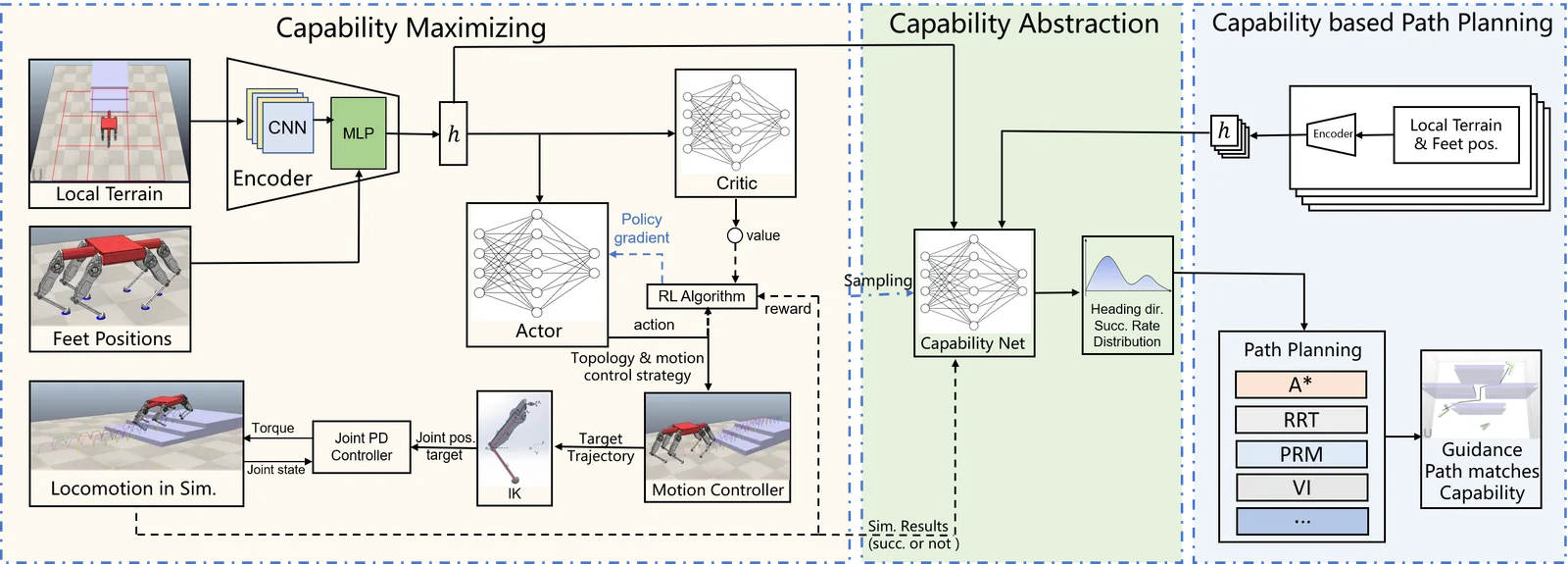
A legged robot’s ability to cross terrain depends on its structure, its topology, and its locomotion controller. Existing planners ignore this: they produce paths without asking whether the robot behind them can execute the motion. This project makes the robot’s traverse capability — its terrain- and controller-dependent success rate — a learned, queryable model at the heart of both control and planning.
Research problem
Two coupled questions drive the work:
- Given the current terrain, which control strategy and body topology maximize the robot’s chance of getting through?
- Given a learned picture of that capability, how should a global planner choose long-range paths?
System
The system has three learned components on top of a classical control stack:
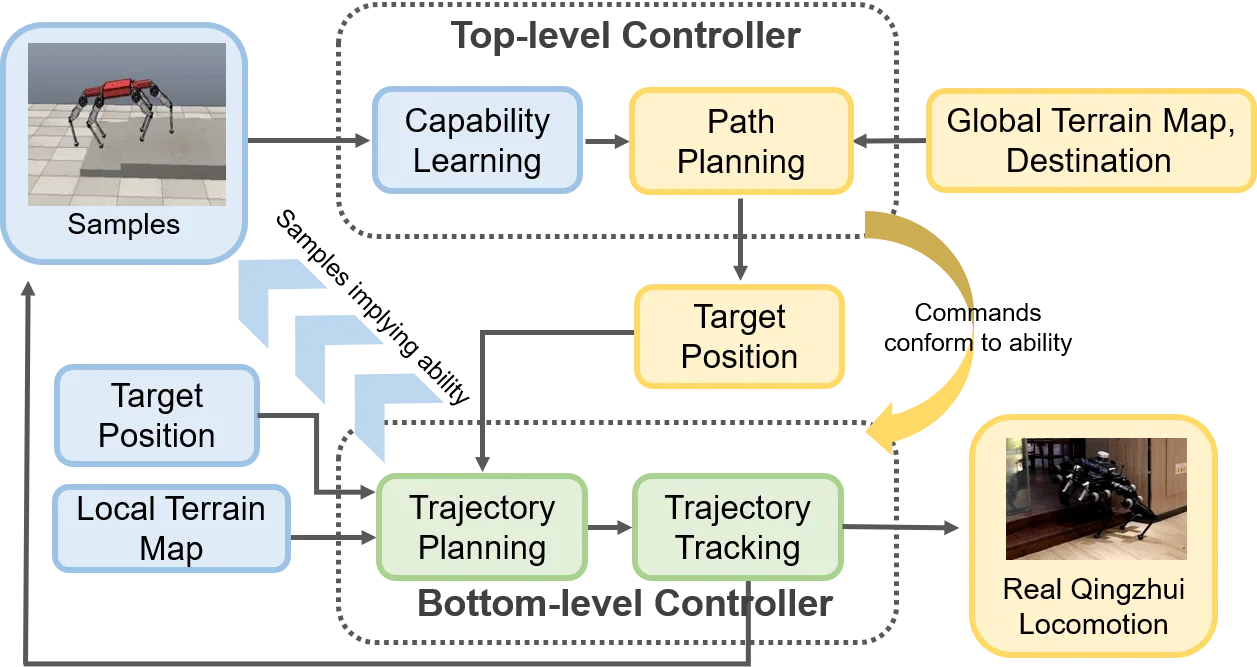
- Capability maximizing — a reinforcement-learning agent picks the best motion-control strategy and topology for the current terrain and foothold state. The chosen controller generates torso and feet trajectories, executed through inverse kinematics and joint PD control.
- Capability abstraction — a supervised network predicts traverse capability from encoded terrain maps and foothold states, trained on large numbers of simulated locomotion trials produced by the low-level layer.
- Capability-based path planning — classic planners are augmented with the capability model so that global guidance paths conform to what the robot can do.
The first version of this pipeline, CapPlanner, was published at ROBIO 2022 and was a finalist for the Best Paper in Biomimetics award. The extended system adds capability maximizing and was published at IEEE RCAR 2024.
Results
We trained the framework in simulation and ran long-range locomotion experiments both in simulation and on the physical Qingzhui hexapod. Across terrains of varying complexity, capability-aware planning substantially improved global locomotion success compared to capability-blind baselines — the robot chooses routes it can survive, and switches topology when the terrain demands it.
Publications
- CapPlanner: Adaptable to Various Topology and Locomotion Capability for Hexapod Robots. Changda Tian, Yue Gao. IEEE ROBIO 2022, pp. 519–524 — Best Paper in Biomimetics finalist. DOI
- Learning Capability to Enhance Locomotion Control and Planning for Legged Robots. Yue Gao, Changda Tian, Yang Zhang. IEEE RCAR 2024, pp. 25–30. DOI