Research theme
Learning from Human Motion
Can robots acquire task-oriented manipulation skills by imitating the style — not just the goal — of human motion?
Adversarial Motion Priors Imitation Learning Sim-to-Real
Robots that share space with people should move in ways people can read and predict. Standard reinforcement learning optimizes task success and produces motions that are effective but alien. Human demonstrations carry a second signal — style — that is worth learning in its own right.
Approach
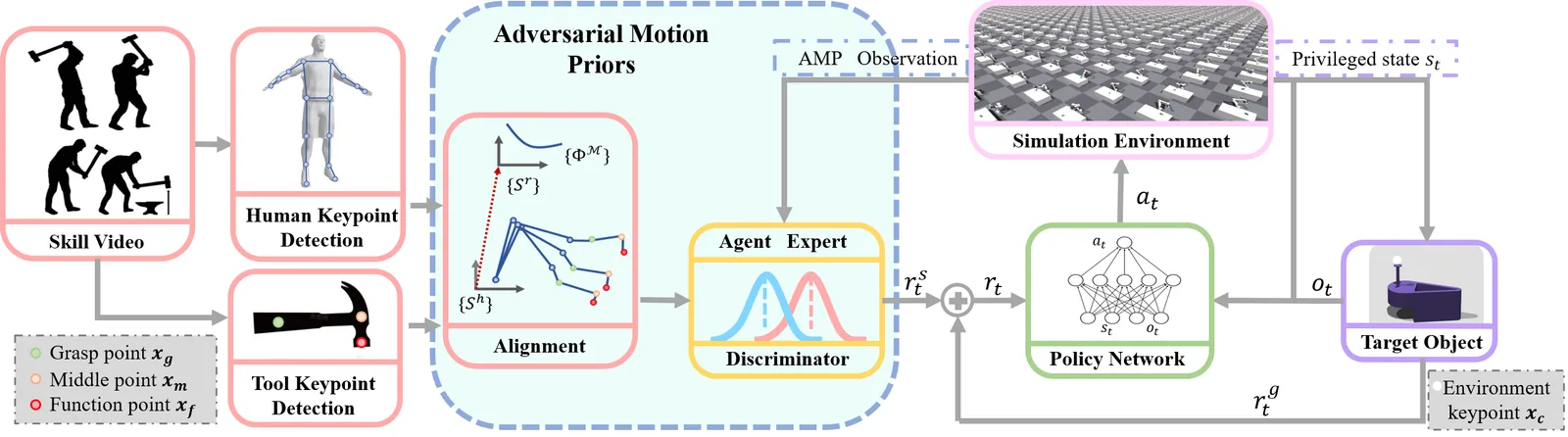
In the HMAMP project (Human-style Manipulation with Adversarial Motion Priors), we extract arm and tool keypoints from human manipulation videos, align them to the robot’s kinematics, and train a discriminator to tell policy-generated motion apart from human motion. The discriminator’s score becomes a style reward added to the task reward, so the policy learns to succeed at the task while moving like a person.
Evidence
We evaluated on hammering, nail clawing, and ball throwing-catching. The learned policies outperform state-of-the-art baselines on benchmark tasks and transfer to a real Kinova Gen3 arm, which hammers nails with recognizably human-like strikes.
Where this is going
Motion priors are a bridge between video-scale human data and robot skills. I am interested in extending them from single-arm tool use to whole-body skills for legged robots — where my locomotion and manipulation research meet.
Projects in this theme
HMAMP: Manipulate as Human
Task-oriented manipulation skills learned from human motion with adversarial motion priors, deployed on a real Kinova Gen3 arm.
- Platform:
- Kinova Gen3 · Simulation
- Methods:
- Adversarial Motion Priors · Reinforcement Learning · Keypoint Alignment
Related publications
Manipulate as Human: Learning Task-oriented Manipulation Skills by Adversarial Motion Priors
Ziqi Ma , Changda Tian , Yue Gao
Robotica · 2025
Human-style, task-oriented manipulation skills learned with adversarial motion priors and deployed on a real Kinova Gen3 arm — now published in Robotica.